| |
 |
API,
being one of the oldest aviation airplane flying flight training pilot schools
in the USA, can prepare you for an airline career. Learn to fly in a real world
professionals environment and acquire your Private Pilot Certificate, Instrument
Rating, Certified Flight Instructor Certificate, and Commercial Pilot License
in minimum amount of time. By using general aviation aircraft and PCATD flight
simulators, you're IFR and CFII training is simplified. Flying is not a job it's
a dream come true. We are located in Chicago, Illinois and Indiana.
Career Pilot
Program Training for
the
Private Pilot
Instrument Rating
Commercial Pilot Certificate
Certified Flight Instructor Certificate
API has been training individuals to become Professional Pilots for over 35 years
Save Time and Money with Training from the Professionals What is
needed to become a Professional Pilot ? - A
professional pilot is an individual who is compensated for his or her ability
to fly an aircraft
-
There are various types of professional pilots and they are normally classified
by the type of company they fly for, or by the type of flying services they provide
- The
major types of professional pilots are:
Commercial Airline Pilots who fly for an international,
domestic, or regional airline Commuter Pilots who
fly normally somewhat smaller airplanes than the airlines Corporate
Pilots who fly for corporations that have their own aircraft Charter
Pilots who fly for companies that provide charter services to the public Agriculture
Pilots who fly aircraft that are used for crop dusting Certificated
Flight Instructors who teach individuals how to fly - Advancing
in the industry is generally related to the total number of flight hours that
the pilot has logged, and the specific type of aircraft that he/she is qualified
to fly
- In
order to fly as a professional pilot, the FAA states you must obtain a commercial
pilot certificate in order to be legally compensated for as a pilot
-
The commercial pilot certificate can be achieved by meeting the FAA requirements
dictated in either FAA part 141 or FAA part 61
- Under
FAA part 141 you could become a commercial pilot with 190 hours of flight time,
but you must attend mandatory ground school classes
-
Under FAA part 61 there are no mandatory ground school classes, and the required
flight time is 250 hours
- With
some FAA part 141 organizations the mandatory ground school classes can add as
much as $11,000 to the cost of your training
- With
FAA part 141 you are trading ground school classes for flight time
- The
required testing is exactly the same for all commercial pilots regardless if you
are being trained under FAA part 141, or FAA part 61 regulations
-
Your actual commercial pilot certificate conveys that you can be legally compensated
for flying an airplane, but does not indicate if you were trained under part 141
or 61
- Quite
often you will spend less money, and obtain more flight hours when you are trained
under FAA part 61 as opposed to FAA part 141 because you do not have to pay for
mandatory ground school classes
- The
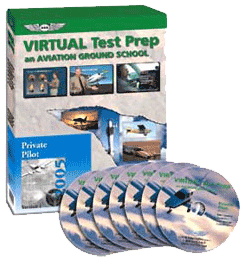
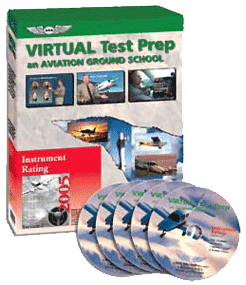
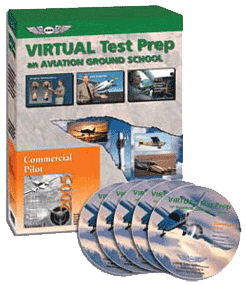
mandatory ground school classes have become obsolete because all major ground
training is now done using state of the art DVD interactive home study training
augmented with one on one individual training if necessary
- The
total flight hours obtained may make it easier to advance in the industry
- When
you send a resume to a prospective company your total flight time can be the major
factor to meet their hiring minimums
- In
the real world even with 250 hours of flight time and a commercial pilot certificate
there are very few entry level jobs available for you in the industry because
of FAA requirements and insurance minimums
- A
realistic approach to get your professional career off the ground is to become
a certificated flight instructor
- As
a certificated flight instructor each time you fly with a student you are allowed
to add that flight time to your total flight hours, and you are getting paid for
your training skills
- Aviation
Professionals takes a real world approach towards your career as professional
pilot by incorporating your training to become a commercial pilot with training
towards a flight instructor certificate
- This
combined training concept will save you time and money, and it also produces a
better commercial pilot because you will obtain more in-depth flying skills
- The
core of the concept is while other pilots are learning only how to perform a maneuver
you are learning how to simultaneously perform, and explain the maneuver which
is exactly what is required of a flight instructor
- Aviation
Professionals will start grooming you to become a certificated flight instructor
while you are working on your private pilot certificate
- This
concept produces a seamless training experience from your private pilot certificate
to your flight instructor certificate
- The
industry norm is to first be trained to become a commercial pilot, and then after
you have achieved that they will train you to become a flight instructor which
means extra training, and more money
- Our
expertise in the industry comes from our 35 years of experience of training pilots
in some of the world's busiest airspace, and to our knowledge every major airline
in the United States has a pilot who was trained by Aviation Professionals
General
Information for All Certificates - Flying
an airplane can be simple and easy, when you pay attention to details
- Flying
is about 92 times safer than driving an automobile
- The
Federal Aviation Administration (FAA) establishes the requirements
for pilots
- You
need to able to read, write, speak, and understand the English language
- All
pilots must pass a flight physical which is a general exam confirming that
your health will not hamper your ability to fly and airplane
- For
each individual pilot certificate you will be required to pass a
written, oral, and flight exam that is related to the certificate that
you are trying to acquire
- The
written exam, also called a knowledge exam, requires a score of 70%
or higher to pass
- You
will be required to pass an oral exam administered by a FAA flight examiner
on the day of your flight test
- The
flight test is an actual flight whereby you demonstrate your
flying abilities to an FAA examiner
Private
Pilot Certificate - As
a Private Pilot you can fly any where in the country and take passengers
with you
- You
have to be at least 16 years old before you can fly by yourself which is
called solo flight
- You
must be at least 17 years old to be awarded your Private Pilot Certificate
- For your
Private Pilot Certificate you must have a minimum of 40 hours of physical flight
time
- Your
flight time will consist of flying with an instructor which is called dual
flight, and flying by yourself which is called solo flight
- You
can start your training without a physical, but must pass a flight physical
before soloing
- Private
Pilots can not receive money for their ability to fly an airplane
Instrument
Rating - An
Instrument Rating means you are certified to fly in poor weather
conditions solely by reference to the airplane's flight instruments without
having visual contact with the ground
- You
must have at least a Private Pilot Certificate before you can become an
Instrument Rated Pilot
- You
must be at least 17 years old to be awarded your Instrument Rating
- For
your Instrument Rating you must have a minimum of 40 hours of flight training,
and 50 hours of actual cross country flying
- Your
training is a combination of ground simulator, and actual
flight time
Commercial Pilot Certificate
- As a Commercial
Pilot you can be paid for you ability to fly an airplane
- You
must be at least 18 years old to be awarded your Commercial Pilot Certificate
- For
your Commercial Pilot Certificate you must have 10 hours of training
in a complex airplane a minimum of 250 of total time
- Your
total time can be a combination of your time acquiring your Private
Pilot Certificate and Instrument Rating including your ground simulator
time
Certified Flight Instructor Certificate
- As a Certified
Flight Instructor whenever you are training a student, you are accumulating
additional hours to your total flight time while being paid for your pilot
training skills
- You
must be at least 18 years old and hold a Commercial Pilot Certificate
- You
can become a Certified Flight Instructor immediately after obtaining your Commercial
Pilot Certificate
Why is
Aviation Professionals Incorporated - API Your
best choice for a Flight School ?
35
Years of Providing Professional Training In
some of the World's Busiest Airspace - Only
a few schools in the country can boast they have been training pilots for over
3 decades
-
API, for over 3 decades, has been training individuals to become
Private Pilots, Instrument Rated Pilots, Commercial Pilots, Certified Flight Instructors,
and Airline Transport Pilots
- We
can boast that almost every major airline has had pilots who were trained
at API
- We
have hundreds of thousands of hours in experience with our programs
-
Even the United
States Air Force had contracted with us to teach some of their cadets how
to fly before those individuals entered the Air Force Academy
Simplicity in Training Using Attitude
Flying, and the CAP KISS Concept
- API has developed
its own exclusive, and unique training method over the last 35 years
- Our
method of training is based around simple common sense techniques and procedures
- The
technique is called ATTITUDE FLYING, and the procedures
are called CAP
- ATTITUDE
FLYING using our CAP procedures makes flying simple, safe, and easy
to understand
- ATTITUDE
FLYING provides you with instant feedback as to what the airplane is
doing
- The
CAP procedure
is CONTROL - ATTITUDE - PERFORMANCE
- A
pilot flies an airplane using hand and foot CONTROLS
- When
explained properly you will understand that the airplane's CONTROLS have very
simple movements
- When
moving the controls you need to have an instant visual reference to see
how the airplane is reacting
- These
visual references are specific ATTITUDES that are created by comparing
the relationship that certain parts of the airplane make relative
to the ground, runway, or horizon
- Maintaining
a specific attitude will produce specific aircraft PERFORMANCE
- You
will move the CONTROLS to acquire specific ATTITUDES to get the
desired PERFORMANCE
- API's
system has proven to work universally with both private, and commercial
aircraft
- API
is the only place in the world that teaches ATTITUDE FLYING, and the
CAP procedures
Location
and Professional Environment
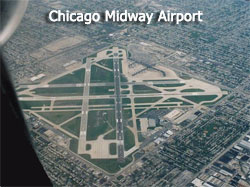
- Learning to fly at
Chicago Midway Airport, or at Gary-Chicago Airport is invaluable
-
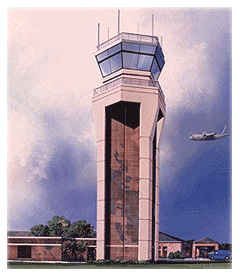
In the Unites States, all major cities that have airports, will have Control
Towers
- To
be able to utilize all the airports, in addition to knowing how to fly an
airplane, you also have to know how to communicate with the air traffic
controllers
- The
controls towers have controllers responsible for the efficient and safe
movement of all aircraft traffic on and around an airport
- Both
Midway Airport, and Gary Airport have Control Towers manned
with air traffic controllers
- Training
at API will teach you the proper procedures to communicate with the
air traffic controllers and radar controllers
- An
airport that has a control tower creates an extremely safe, and
efficient environment because there is an additional staff of individuals
coordinating the flow of traffic
- Smaller
airports do not have control towers so it is very difficult to understand
and practice your communication skills with air traffic controllers
- Learning
to fly at Midway Airport, or Gary Airport gives you the confidence
to use other major airports because you are well versed, and familiar in using
proper radio procedures
- If
you wish to be a professional pilot then you need the skills to fly
in an professional environment
State
of the art DVD Interactive Ground School
Training
|
Chicago Midway Airport Southwest Corner of Airport
6321 S. Central Ave Chicago, IL 60638
(773)-284-5678
To Get MapQuest Directions |
Gary-Chicago Airport Just East of Main Terminal
5701 W. Industrial Highway Gary, IN
46406
(219)-944-5678
To Get MapQuest Directions |
 Open
7 Days a Week
Be
one of the best pilots you can be, and learn to fly in a professional commercial
environment. We are one of the oldest aviation airplane flying flight training
pilot schools in the USA, and we can prepare you for an airline career. Obtain
your Private Pilot Certificate, Instrument Rating, Certified Flight Instructor
Certificate, and Commercial Pilot License in minimum amount of time and at minimum
expense. Utilizing general aviation aircraft and PCATD flight simulators, you're
IFR and CFII training is simplified. We have schools in Chicago, Illinois and
Northwest Indiana. Flying does not have be to considered a job, instead it
can become a dream come true.
| |
| | | | |
Email
Us|| Home
|| Flight Training
Private Pilot ||
Instrument Rating ||
Career Pilot Training||
AvTEST ATP ||
Pilot Shops
|| FAA and
FCC Written Exams ||
F A Q |